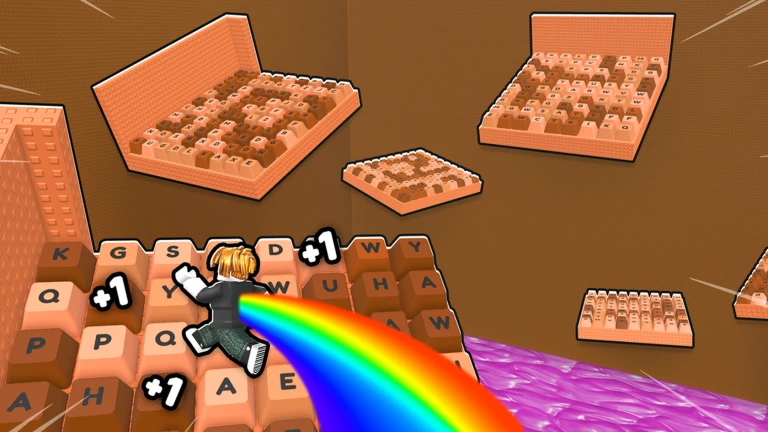
Farm the longest keyboard route you can finish repeatedly, not the hardest route you can reach once. Track clean completions and resets, use visible multipliers on a route you already control, and move to stage attempts only when failures no longer consume most of the session.
Understand what the official loop guarantees
The creator listing says every step gives Speed, players run and jump across candy and chocolate keyboard keys, multipliers can be unlocked, and one wrong move can send the player back to the start. Those facts make movement consistency the foundation of progression. They do not publish exact multiplier values, stage counts, rebirth formulas, or item stats. Begin by learning how your avatar responds at the current Speed. A route that awards steps but causes constant resets may produce less useful progress than a simpler lane completed repeatedly. The first goal is to connect movement, Speed gain, and reset risk in a run you can reproduce.
Choose a safe lane and establish a baseline
Pick a keyboard lane or obstacle segment you can recognize and repeat. Run it for a fixed number of minutes or attempts. Record clean completions, resets, and the point where control usually breaks down. Do not change camera settings, route, bonus state, and risk level at the same time. A baseline should answer whether the route is stable, not how impressive one attempt looked. If most attempts end before the useful section, step back to an easier line. When clean runs outnumber resets and the movement rhythm feels predictable, the lane is ready to support farming or a controlled experiment.
Treat control as part of the Speed calculation
More Speed changes how much correction a jump or turn may require. If the current pace makes the avatar overshoot keys or lose the camera line, increasing risk can reduce productive movement. Use consistent camera placement, repeat the same approach angle, and slow your decision-making even when the avatar is faster. The specialist guide calls this a safe-lane method because it values repeatable steps over reset-heavy attempts. Track where failures happen. If they cluster at one jump, practice that transition separately or farm before it. The useful outcome is not maximum raw Speed; it is a route where Speed can be converted into steady progress.
Use visible multiplier windows on a route you know
The official description confirms powerful multipliers but does not disclose their exact values or duration. When a visible multiplier or group benefit is active, avoid spending the window learning an unfamiliar reset-heavy path. Use the route that already has a clean baseline so the changed condition can be observed. Mark the bonus state in your notes and do not compare that session directly with an ordinary run. If the current interface or official group surface presents a benefit, record only what your account visibly receives. Do not turn an unverified community report into farming input, and do not delay ordinary progression while searching for a reward the checked sources cannot support.
Move from farming to stage pushes with a stop rule
Attempt harder stages after the safe route is repeatable and extra farming no longer changes the immediate control problem. Decide in advance how many resets you will accept. If repeated failures consume the session, return to the baseline route, rebuild control, and try later. Stage pushing should test whether the current Speed and rhythm can cross a new obstacle, not become an endless sequence of unmeasured resets. The reviewed same-game source recognizes official WORLD2 and WORLD3 labels but does not publish a stable stage table. Follow the current interface and route in your server, and avoid copying exact stage names or counts from an unverified video.
Review the run before rebirth or another upgrade
At the end of the session, compare clean completions, resets, and the point where the route failed. If the same obstacle remains the problem, more control practice may be worth more than another risk increase. If the run is stable and a visible multiplier or reset option promises a better next session, move to the planner before committing. Record what the live interface says will reset and remain; the available sources do not supply a universal rebirth table. After any reset, major upgrade, or update, create a new baseline. That prevents an old movement pattern from being treated as current evidence when the avatar or route behaves differently.
What changed across observed Roblox snapshots
This is our own dated history of the same public Roblox fields. It shows observed movement, not a prediction or an explanation for why players moved.
Source: QuestSignal immutable release history · newest five observations shown
What this guide does not assume
The guide uses official step-to-Speed, obstacle, multiplier, racing, and reset-to-start statements plus a conservative owned route method. It does not claim exact multiplier, rebirth, trail, treadmill, aura, world, or stage values.
Refresh trigger: Refresh after an official description or title-state change, a route or world change, a verified multiplier or rebirth rule, or first-hand evidence showing different reset or movement behavior.