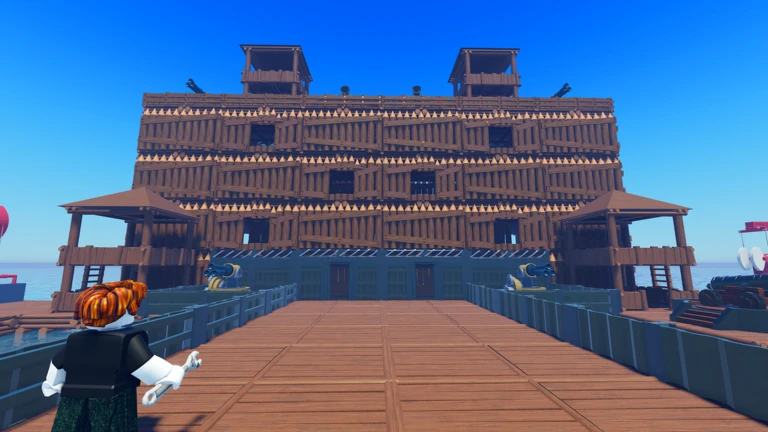
Start by confirming universe 9167377564, then use the creator's four published jobs as the run loop: gather resources directly or with the Harpoon, build raft structures and defenses, explore islands, and use found weapons against foes. Record visible changes instead of assuming costs or recipes. Official badges give safe checkpoints at day 1, 5, 10, and every ten days through 100, while also confirming bonfire, cooking, island, party-size, raid, challenge, boss, and puzzle goals without documenting their full solutions.
Confirm the exact ocean-survival universe
This guide covers 100 Days At Sea, universe 9167377564 and root place 70411440483149, from Stranded Devs. Roblox classifies it as Survival and currently allows up to 27 players in a server. The creator frames the experience as an open-world survival mission in the Bermuda Triangle where exploration and base building matter. Similar day-survival games do not share its items, recipes, enemies, or timing. Open the official place from this page and verify the title and creator before applying any code list, map, crafting chart, or strategy from another experience.
Use the four official jobs as the first-run loop
The creator names four actions: grab resources or hook them with the Harpoon, build the raft with structures and defenses, explore the sea and mysterious islands, and find weapons to face foes. That is enough for a reliable task order, but not enough for an exact shopping list. During the first session, record the visible resource label, how it enters storage, the build option shown, and the resulting raft change. If the interface presents a different order, follow the live prerequisite instead of forcing a third-party route. The page does not assume crafting costs, tool durability, storage capacity, or enemy damage.
Make the Harpoon your first observable milestone
The enabled Hooked! badge says to grab an object with the Harpoon. This confirms a specific first-run goal without revealing controls, range, cooldown, eligible objects, or whether the Harpoon is immediately equipped. Find the live Harpoon label, note the platform prompt, select one nearby object, and verify that the object actually moves or enters the raft's usable area. If the badge or action does not register, preserve the object type, prompt, server time, and result. Do not convert one successful grab into a universal list of hookable objects.
Build for an observed need, not a perfect-base claim
Official text verifies raft structures and defenses, while current videos show that players search for base layouts. Neither source publishes a single best arrangement. Before placing anything, identify one visible problem: insufficient working space, exposed access, scattered storage, or a route that blocks movement. Place one structure or defense whose current label appears to address that problem, then retest movement and the next encounter. Keep the cost, footprint, orientation, and effect tied to the live session. A screenshot can prove one layout existed; it cannot prove optimality across party sizes, updates, or later threats.
Track day milestones in small steps
Official badges mark day 1, 5, 10, 20, 30, 40, 50, 60, 70, 80, 90, and 100, with Rescued! attached to day 100. Use these as a progress ladder rather than treating 100 days as one opaque target. At each checkpoint, record party size, raft state, current bonfire level if visible, unresolved needs, and the next island or defense goal. Badge labels do not disclose how long a day lasts, whether time can accelerate, what happens after failure, or which actions are mandatory. Those rules stay bound to the current client.
Treat bonfire and cooking as verified categories
The current badge inventory names Bonfire levels 1 through 9, says Bonfire 8 involves burning 1,500 items in one session, and says Bonfire 9 requires reaching maximum level with four or more people. It also names cooking the first chowder with a cooking pot. These labels confirm progression and cooking categories, not fuel values, maximum-level requirements, ingredients, recipes, nutrition, or the shortest upgrade path. When a live bonfire or pot appears, capture its exact label, starting state, offered input, and result. Do not publish a recipe or fuel calculator until repeated exact-game evidence supports it.
Separate island exploration from completion claims
The Magellan badge says to visit all islands in one session, and the creator tells players to explore mysterious islands. That verifies an island-completion task but not the island count, map coordinates, visit trigger, safe route, or whether new updates change the set. Create a session checklist from the island names actually displayed to your party and mark an island only after the live game signals arrival or the relevant progress changes. If no counter exists, keep the list as a personal observation rather than calling it complete. Current creator images are identity assets, not a navigational map.
Choose party-size goals from official badges
Enabled badges explicitly distinguish surviving 100 days solo, in a duo, trio, group of four, and full group of five. This supports a party-size planning choice without proving difficulty, scaling, loot sharing, revive rules, or matchmaking. Decide the intended party size before the run and keep it stable if you want the badge goal to remain interpretable. Record joins, leaves, disconnects, and the final day because the badge descriptions do not say how substitutions are handled. A larger group is not automatically easier, and a solo badge does not prove a particular class, weapon, or raft design is required.
Refresh only when the playable loop changes
Update this guide when the creator or a replayable exact-game capture changes the resource, Harpoon, raft, defense, island, weapon, foe, day, bonfire, cooking, or party-size workflows. CCU, visits, favorites, video views, and a new calendar date are demand or counter observations, not semantic changes. Boss solutions, challenge tiers, potion recipes, codes, and best-base claims remain separate research tasks until their current steps and evidence can be reproduced.
What changed across observed Roblox snapshots
This is our own dated history of the same public Roblox fields. It shows observed movement, not a prediction or an explanation for why players moved.
Source: QuestSignal immutable release history · newest five observations shown
What this guide does not assume
This guide verifies exact identity, Survival classification, server size, resource collection, Harpoon use, raft structures and defenses, island exploration, weapons and foes, day milestones, bonfire and cooking categories, and official party-size survival goals. It does not certify controls, recipes, item names, costs, yields, locations, maps, enemy statistics, day length, revive rules, rewards, codes, or an optimal base.
Refresh trigger: Refresh when official wording, enabled badges, or reproducible exact-game evidence materially changes the first-run resource, Harpoon, raft, defense, island, day, bonfire, cooking, or party-size tasks.