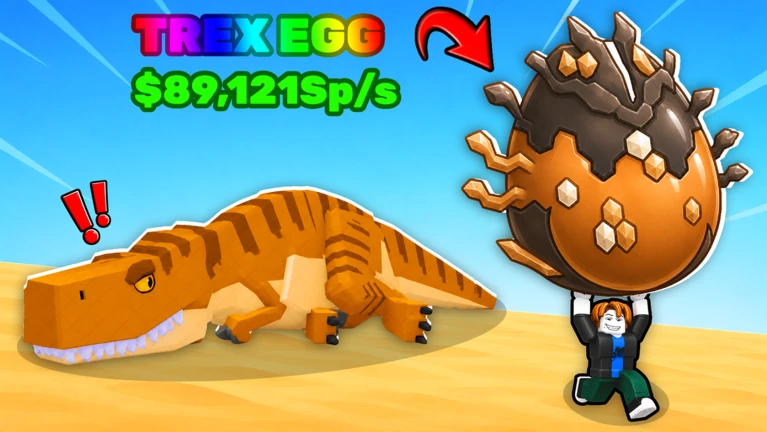
Confirm that you joined universe 10563114921, choose one visible egg target, and follow the live server's interaction prompt without assuming controls from another game. After the attempt, separate the hatch result, pet-income change, and one base or treadmill comparison; the current official record verifies the direction of the loop but not routes, controls, rates, prices, or guarantees.
Confirm the current game before planning a run
Start by checking the Roblox URL or game details for place 107778070777162 and universe 10563114921, published by the group and Collect Rare Pets. Search results also surface an older experience named Steal a Egg at a different place and universe. Its rebirth, troll-gear, reward, or control claims do not belong in this guide. In the current game, the creator's description verifies the main sequence: steal eggs from pets, hatch eggs into rare pets, earn money from pets, improve the treadmill and base, train Speed, and steal eggs from other players. Treat that sequence as the session map while letting the live interface supply the current controls and labels.
Record a clean starting checkpoint
Before moving toward an egg, note five visible items: your current money, Speed, equipped or displayed pet state, the nearest base or treadmill choice, and one egg target you can clearly identify. A clean checkpoint prevents several changes from being credited to the wrong action. The current official description does not publish starting values, a universal treadmill rate, or a fixed egg route, so record what your account shows instead of copying a number from a thumbnail. If a reward, boost, or previous session changes the display immediately after joining, wait for the state to settle and write that condition beside the baseline.
Choose one egg target and one exit decision
Roblox verifies two theft directions: eggs can be stolen from pets and from other players. The checked first-party text does not explain every location, defense rule, collision, safe zone, or device control. Pick a single visible target and inspect the live prompt or requirement before committing. Decide in advance what will make you stop: the prompt is unavailable, the target changes ownership, another player contests it, or your return path becomes unclear. Then perform only the interaction the current server displays. A failed attempt is useful when you classify it as a requirement problem, an interaction problem, player interference, or an unknown state instead of repeating random inputs.
Separate the theft attempt from the hatch result
After an egg attempt, confirm whether the account actually gained an egg before discussing a hatch. If the egg is present, follow the current server's hatch flow and record the displayed result exactly. The official description says eggs hatch into rare pets and that rarer eggs, pets, sizes, and mutations exist, but it gives no complete roster, odds, timer, or guarantee. Current videos show player interest in lava, huge, and boss eggs, while creator media presents Yeti, T-Rex, cosmic, and Eternal Phoenix scenes. Those names and images are investigation targets, not proof that a particular run must produce them. Keep one dated result separate from universal probability.
Measure pet income before choosing an upgrade
Roblox states that pets earn money. It does not publish a universal income table or confirm that every promotional number remains live. Note the money display, observe one consistent interval with the same pet and base state, and record the change. Repeat once before comparing anything. If the result varies, check whether the pet, size, mutation, base, temporary reward, or server state changed. The measurement only needs to reveal the current bottleneck. If income is too slow for the next visible base or treadmill choice, preserve the baseline and compare one upgrade at a time. Do not label a pet best from one account or turn creator artwork into a permanent rate.
Compare one base or treadmill change
The official description verifies that both the treadmill and base can be upgraded and that treadmill training gains Speed. Before spending, copy the visible cost and stated effect of the choice you are considering. Make one change, then repeat either the same income interval or the same Speed sample—not both at once. A current exact-game video title exposes interest in the treadmill, but it does not establish a rate, TikTok feature, best upgrade order, or device behavior. Choose according to the next demonstrated obstacle: improve Speed when reaching or escaping a target is the problem, or improve the base when the live upgrade clearly addresses your observed earning or storage bottleneck.
End with a six-line run card
Save the review date, exact universe, selected egg target, theft outcome, hatch result, and one measured money or Speed comparison. Add a seventh line only when another player changed the attempt. This small record keeps the current game, promotional media, community titles, and your own account state from blending into an unreliable rule. On the next session, repeat the smallest baseline before chasing a rarer egg. If the official description, media, theft prompt, hatch interface, pet-income display, base upgrades, treadmill behavior, or Speed presentation changes, begin a fresh card. The durable method is identity first, one action at a time, and explicit unknowns.
What changed across observed Roblox snapshots
This is our own dated history of the same public Roblox fields. It shows observed movement, not a prediction or an explanation for why players moved.
Source: QuestSignal immutable release history · newest five observations shown
Use the dedicated Steal An Egg site for deeper tasks
QuestSignal keeps discovery and dated history here. The exact-identity specialist site owns deeper game-specific coverage, so we link to it instead of duplicating a thinner version.
What this guide does not assume
The guide uses the current official steal, hatch, rare-pet, money, treadmill, base, Speed, player-theft, size, and mutation statements plus creator-supplied media and reviewed exact-game task demand. It does not assert device controls, fixed routes, guard behavior, return requirements, theft timing, egg odds, pet income, upgrade prices, treadmill rates, defense methods, active codes, or older-game rebirth and troll-gear mechanics.
Refresh trigger: Refresh after a material title or description change, replacement official media, a verified live theft or hatch-flow change, or a changed pet-income, base-upgrade, treadmill, or Speed presentation.