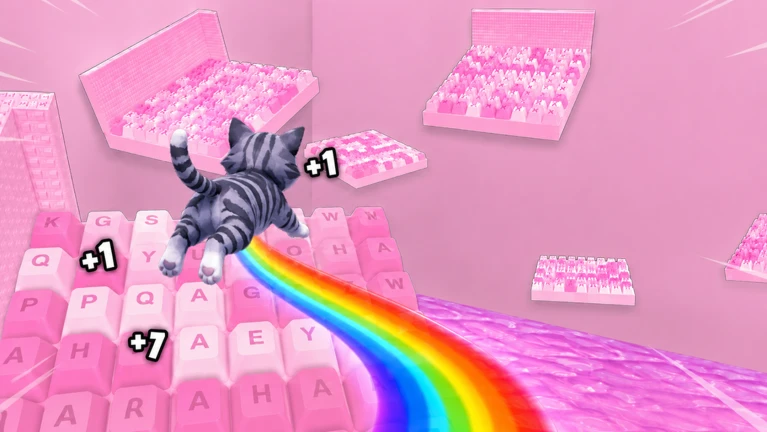
Start with a short route you can repeat cleanly, record where control breaks, and push a harder stage only after the same approach works several times. Treat group gifts and weekend multipliers as separately checked session conditions, not as permanent progression math.
Read the live loop before optimizing it
The official experience description gives the stable starting point: moving makes the kitten stronger, jump power helps the player reach higher sections, stages lead toward multipliers, and a bad jump can send the run backward. Use those statements as the first-session map. Do not begin with a code list, a supposed best upgrade, or a number copied from another keyboard-escape game. Enter the current server, identify which visible action changes progression, and locate the nearest repeatable obstacle segment. The goal of the first few minutes is to understand how this specific kitten responds. A short completed segment teaches more than a long attempt whose failure point you cannot explain.
Build a three-attempt movement baseline
Choose one recognizable stretch near the current checkpoint and run it three times with the same camera angle and approach. After each attempt, note whether the kitten landed cleanly, corrected late, overshot, or fell because the next surface was not visible. Keep the route and camera stable while collecting this baseline. If all three attempts fail in different ways, the problem is still observation rather than progression. Slow the setup and learn the takeoff point. If the same transition fails repeatedly, practice the approach instead of adding more unrelated changes. A baseline is ready when you can describe what the kitten will do before the jump begins.
Choose between training and a stage push
Use control, not impatience, to choose the next run. Continue training when the kitten still overshoots familiar surfaces, the camera loses the landing area, or most attempts end before the section you want to study. Try a stage push when the familiar route is repeatable and the next obstacle is the only unresolved part of the run. The official page confirms that strength, jump power, stages, and multipliers are connected, but it does not publish exact requirements. Read the live interface for any current gate and avoid turning one player's visible value into a universal threshold. The decision is whether the present movement is reliable enough to test something harder.
Give every stage push a reset budget
Before attempting a harder section, decide how many falls or how many minutes you will spend before returning to the baseline route. A useful starting budget is a small number of deliberate attempts, not an endless sequence of rushed jumps. Keep the approach consistent so each failure answers a question: was the takeoff early, was the landing hidden, did the camera turn too late, or did the current route demand a different setup? When the budget expires without a clearer answer, return to the repeatable segment and rebuild the rhythm. The independent captures prove that players want later-stage routes, but they do not make every recorded layout permanent or every video instruction current.
Separate ordinary runs from bonus conditions
The creator description currently advertises a group gift and a weekend three-times multiplier. Those are conditions to verify in the current account, not assumptions to bake into every recommendation. Record whether the interface actually displays the benefit, when the session took place, and what changed visibly. Do not compare a weekend run directly with an ordinary baseline and call the difference a permanent upgrade. If the gift is unavailable, account-sensitive, or already claimed, continue with the normal progression loop rather than searching for a reward the page cannot guarantee. This separation keeps the guide useful after a promotion changes and prevents temporary conditions from becoming false evergreen facts.
Review one failure and change one input
At the end of a session, select the first decision that made the run unreliable. It may be a camera angle that hid the landing, a rushed takeoff, a route that was too long for the current control level, or a stage push attempted without a stop rule. Change only that input next time. Do not simultaneously switch route, camera, bonus condition, and progression target, because the result will not show what helped. Save the baseline, the failed transition, and the next test in a short note. If an update changes movement, stages, or multiplier presentation, discard the old comparison and create a new baseline from the live game.
What changed across observed Roblox snapshots
This is our own dated history of the same public Roblox fields. It shows observed movement, not a prediction or an explanation for why players moved.
Source: QuestSignal immutable release history · newest five observations shown
What this guide does not assume
The guide uses the official move-strength, jump-power, obstacle, stage, multiplier, racing, group-gift, weekend-bonus, and fall-reset premise plus reviewed same-game capture demand. It does not assert exact strength gains, stage counts, jump requirements, multiplier values, checkpoint behavior, gift contents, codes, or shortcuts.
Refresh trigger: Refresh after an official description or title change, a verified movement or checkpoint change, a new stage layout, or current replayable evidence that contradicts the baseline routine.