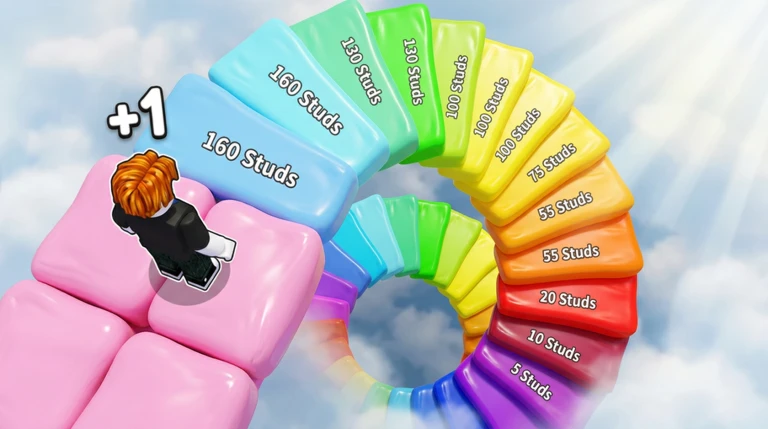
Walk long enough to confirm how the current Jump display changes, test one nearby route segment with a fixed camera, and attempt a longer push only after that segment is repeatable. Check any ASMR reward, upgrade, or finish result in the live server instead of assuming the promotional images define permanent values.
Start from the loop Roblox actually states
The current Roblox description gives a short, usable loop: every step adds one Jump, crunchy ASMR interactions offer extra rewards, training supports higher jumps and upgrades, and reaching the finish earns Wins. Treat that as the map for the first session. Before copying a route from a clip, identify the live Jump display, the nearest safe surface, the current finish direction, and any visible interaction prompt. The experience was updated on August 12, 2026, so a recorded path or old screenshot can lag behind the server. Your first goal is not maximum height. It is to confirm which visible action changes Jump and to complete one short movement sequence that you can describe and repeat.
Create a step-and-jump baseline
Pick a clear starting point and take a short, counted walk while watching the live progression display. The creator says every step gives plus one Jump, but boosts, temporary conditions, or update changes may affect what appears in your session. Record the starting and ending display rather than turning one run into a universal formula. Next, use the same nearby jump three times with one camera angle. Note whether the landing is visible, whether you stop before takeoff, and whether your avatar consistently reaches the same surface. A baseline is ready when both the movement change and the jump result are repeatable. If either varies, shorten the route and change only one input before testing again.
Use route labels as questions, not promises
Current creator-supplied Roblox media shows a spiral of colorful crunchy platforms labeled with distances such as 5, 10, 20, 55, 75, 100, 130, and 160 studs. Those images are useful for understanding the experience's jump-course presentation, but they are promotional assets rather than a complete live requirement table. When the server shows a label, compare it with the route you can already clear and attempt the smallest unresolved step first. Do not assume every image remains available, that labels appear in the same order, or that a number alone guarantees success. Camera setup, takeoff position, avatar state, and current progression can still matter. The live route owns the decision; the artwork only tells you what to inspect.
Test crunchy ASMR rewards separately
The official description says players can squish and crunch satisfying ASMR objects for extra rewards and unlock new satisfying ASMRs. It does not publish a complete object list, reward table, cooldown, or best choice. When you find a current interaction, capture three facts: the prompt or object name shown, the visible state before the interaction, and the visible change afterward. Keep that test separate from a long walk or finish attempt so you can tell what caused the result. If nothing changes, check whether the prompt completed, whether the object is currently available, and whether the interface names an eligibility condition. Do not repeat a third-party reward claim until the same result can be reproduced in the current server.
Make one deliberate finish push
Attempt the finish after the baseline route is controlled and the next visible gap is the only unresolved part. Set a small attempt budget before starting. After each miss, classify the failure as an unseen landing, an early takeoff, a late correction, or insufficient current reach. Fix one category instead of adding more walking automatically. When you reach a finish, record the Wins display before and after because the official page verifies that finishes earn Wins but does not state the amount or every condition. Then inspect which upgrade or route choice is visibly available. A useful finish review answers what changed, what remains locked, and which short test should come next; it does not declare one run to be the permanent fastest method.
End with a four-line session note
Write down the review date, the Jump baseline you observed, the last repeatable route segment, and the first unresolved question. Add a fifth line only when a visible ASMR interaction or finish changed a named display. This small note prevents temporary boosts, creator artwork, and another player's route from blending into one unreliable memory. On the next session, repeat the baseline before comparing progress. If the title, description, course art, zone layout, trampoline presentation, or reward interface has changed, start a fresh note and retire the old route assumptions. The guide remains useful by preserving a method: verify the live state, isolate one decision, reproduce the result, and treat every unsupported number as unknown until the current game proves it.
What changed across observed Roblox snapshots
This is our own dated history of the same public Roblox fields. It shows observed movement, not a prediction or an explanation for why players moved.
Source: QuestSignal immutable release history · newest five observations shown
Use the dedicated +1 Jump Crunchy ASMR Escape! site for deeper tasks
QuestSignal keeps discovery and dated history here. The exact-identity specialist site owns deeper game-specific coverage, so we link to it instead of duplicating a thinner version.
What this guide does not assume
The guide uses the current official step-to-Jump, crunchy-ASMR reward, training, upgrade, finish-to-Wins, zone, trampoline, and new-ASMR statements plus current creator-supplied course media and reviewed same-game task demand. It does not assert permanent route order, exact requirements, reward amounts, upgrade costs, pets, auras, offline-reward rules, codes, or shortcuts.
Refresh trigger: Refresh after a material title or description change, a verified live progression or finish change, replacement official course media, a changed zone or trampoline flow, or replayable evidence that contradicts the routine.