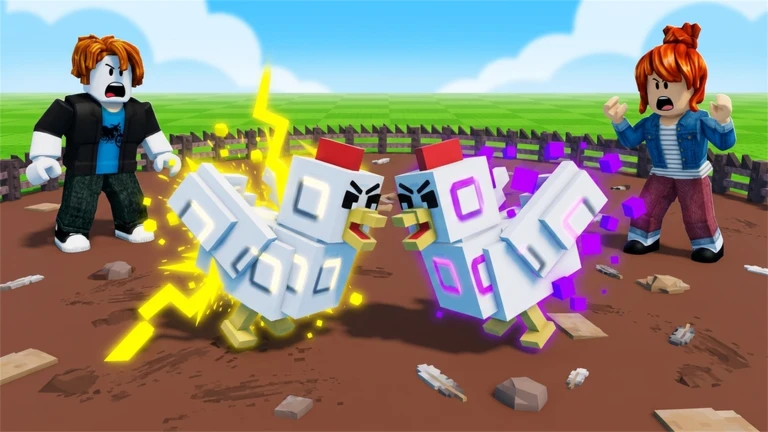
Hatch one chicken, record the current fighter state, run one PIT battle, and compare the visible money state before and after. Approach the TOWER only after that baseline is repeatable. Test fusion or rebirth separately, and do not trust copied odds, stats, recipes, boss thresholds, or rewards without current evidence.
Use the creator-stated progression map
The current Roblox description names a clear set of systems: hatch eggs and collect rare chickens, send chickens to the PIT to fight for money, climb the TOWER and beat bosses, fuse two chickens, rebirth to earn faster, use special abilities, and receive eggs while offline. Treat that as a map of what to inspect, not a complete strategy. At the start, locate the current hatch surface, the fighter details the game actually displays, the money counter, the PIT entrance, and the TOWER direction. The first objective is a single hatch-to-PIT observation whose inputs and result can be described, not the rarest chicken from a thumbnail or tier list.
Hatch one baseline chicken
Use the lowest-commitment hatch that the current interface presents and preserve the visible state before confirming it. Record the egg name only if the server shows one, the cost only if it is visible, and the resulting chicken exactly as displayed. The official description confirms that eggs and rare chickens exist but does not publish egg classes, prices, odds, pity, hatch speed, a complete roster, or rarity effects. One hatch is not enough to infer probability. The baseline is ready when you can identify the chicken in the current interface and distinguish its displayed information from assumptions imported from a video or another player's account.
Test one PIT result before grinding
The creator says chickens go to the PIT to fight for money. Capture the visible money state, selected chicken, opponent or encounter label if shown, and the result message before spending time on repeated battles. The source does not define enemy scaling, damage, health, ability timing, win rewards, loss penalties, or whether money varies. If the first result is unclear, repeat with the same chicken and change no upgrade or fusion state. If it fails, check whether the interface names a requirement rather than assuming the chicken is too weak. A useful PIT baseline tells you what visibly changed and what one decision should be tested next.
Approach the TOWER as a separate task
The official description says players climb the TOWER and beat every boss, but it does not list floors, bosses, requirements, rewards, reset behavior, or recommended fighters. Enter the TOWER only after you have a stable hatch and PIT record, then note the first visible gate, opponent, floor, or instruction. Set a short attempt budget. Classify a failure as access, survival, damage, timing, or unclear interface based only on what the server shows. Do not add an unverified level or stat target. The TOWER section stays useful by teaching how to locate the current blocker and return with one controlled change rather than copying a stale floor table.
Keep fusion and rebirth isolated
Roblox states that two chickens can be fused into a mutated monster and that rebirth helps players earn faster. Those are high-impact actions, so test neither in the middle of an undocumented progression run. Before fusion, preserve the exact displayed state of both selected chickens and read every current confirmation. Before rebirth, record what the live interface says will reset or persist. The creator text does not publish recipes, mutation outcomes, stat inheritance, costs, rebirth requirements, multipliers, or retained items. If the game does not explain a consequence, stop rather than converting a fan claim into advice. Compare one visible before-and-after state and attach it to the review date.
Close with an evidence-backed next step
End with six lines: review date, egg or hatch surface used, chicken displayed, PIT result, first TOWER blocker, and the next isolated question. Add a fusion, rebirth, special-ability, or offline-egg line only after the current server provides a visible before-and-after state. The creator confirms those systems at a high level, not their detailed economy. On the next session, repeat the hatch and PIT baseline before comparing progress because fast updates can change code text, art, prices, gates, or interface flow. If the official title, description, media, or live task changes, begin a new record and retire any recommendation that depended on the old state.
What changed across observed Roblox snapshots
This is our own dated history of the same public Roblox fields. It shows observed movement, not a prediction or an explanation for why players moved.
Source: QuestSignal immutable release history · newest five observations shown
What this guide does not assume
This guide uses the current official hatch, rare-chicken collection, PIT-for-money, TOWER-boss, two-chicken fusion, rebirth, special-ability, and offline-egg statements. It does not assert exact controls, prices, odds, stats, rewards, bosses, thresholds, recipes, multipliers, code rewards, or rankings.
Refresh trigger: Refresh after a material official description, hatch flow, PIT result, TOWER gate, fusion screen, rebirth behavior, offline-egg, special-ability, or creator-media change.