Treat the shift as three separate lanes: the customer in front of you, the cafe state around you, and any event that does not fit the baseline. Follow the live prompt for one ordinary task first, communicate one observation at a time, and change only one response when something looks wrong. The official page verifies the service-and-survival premise but does not publish a permanent anomaly list or winning script.
Confirm the exact alpha client before learning a route
This guide covers Roblox universe 10439568447 and root place 121781732399469, published by the Anomaly Cafe group. The checked title is Anomaly Cafe, and the creator explicitly labels the experience alpha and warns that bugs or issues are expected. Start by reading the live title, description, and any instructions shown after joining. Do not carry a recipe, character label, day target, or anomaly answer from a similarly themed game into this one. The creator says the premise is to work at Emma's Cafe, serve hungry customers, maintain the cafe, and survive anomalies. Those are the safe anchors. Everything more detailed should come from the current server or remain an open question.
Build a three-lane shift baseline
Before pressure rises, divide what you can observe into three lanes. Customer lane covers the person or creature currently asking for service and the prompt attached to that task. Cafe lane covers visible workstations, items, counters, and any state the current interface asks you to maintain. Event lane covers a change that interrupts the ordinary pattern. This is a player note, not a claim that the game exposes three formal systems. Complete one ordinary customer action exactly as the live client presents it, then record what the counter, customer, and room look like afterward. That baseline gives you something concrete to compare when a later scene feels suspicious.
Finish one normal service action before optimizing
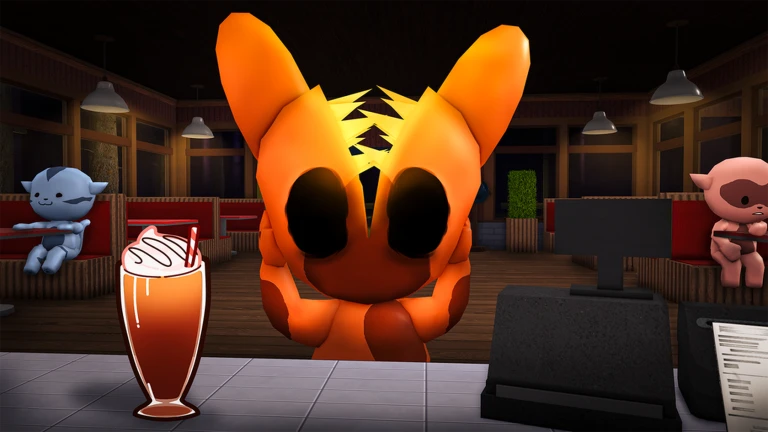
Official media shows staff, customers, a counter, cafe seating, drinks, and food presentation, but artwork does not establish a complete order recipe or input sequence. For the first ordinary task, follow only the visible prompt and current instructions. Identify the requested action, use the workstation or object the server points to, and check for a visible completion or failure state. If the result is unclear, repeat the same short action instead of adding a second task. Avoid memorizing quantities or order steps from an undated clip. A stable first-service baseline matters more than speed because it helps separate a normal customer interaction from an anomaly or an alpha bug.
Use team play as an observation system
The creator tells players to team up with friends, so coordination is part of the verified premise. Keep the role split simple and reversible. One player can stay with the active customer while another watches the surrounding cafe state; swap only after both players describe what they saw. Use short handoffs such as customer handled, workstation changed, or event unknown. Do not turn this into a permanent class guide, because the checked source does not publish fixed roles, player counts, or role bonuses. If playing solo, perform the same checks in sequence rather than simultaneously. The objective is a shared observation trail, not an assumed best composition.
Handle a suspicious event by isolating the change
Creator media includes ordinary cafe scenes, a camera-overlay scene, and horror-styled customer or counter moments. These images establish the intended contrast but do not reveal a complete anomaly tell list. When something differs from your baseline, pause long enough to name the change: customer appearance, prompt, room state, workstation result, or an unknown visual. Check whether the live client offers a specific response. Change only that response and observe the outcome before resuming ordinary service. If nothing clearly links cause and result, mark the event unresolved. A single run, screenshot, or community comment is not enough to declare a universal safe or unsafe customer rule.
Close the session with an alpha-safe recovery note
End the run with the checked date, exact place ID, one ordinary service action you reproduced, one cafe-state change you could explain, and one anomaly or bug question that remained unresolved. If teammates disagreed, keep both observations rather than averaging them into a rule. Current community discussions mention cooking, cameras, solo pressure, numbered days, and unfinished progression, but those are reported questions until replayable evidence binds them to a current version. After an update, repeat the ordinary baseline before using the old note. This protects the next session from stale routes and gives a useful stopping point even when the alpha client changes or behaves inconsistently.
What changed across observed Roblox snapshots
This is our own dated history of the same public Roblox fields. It shows observed movement, not a prediction or an explanation for why players moved.
Source: QuestSignal immutable release history · newest five observations shown
What this guide does not assume
The guide uses current official identity, the alpha warning, the team-service-maintenance-survival premise, creator media, and reviewed exact-game questions. It does not certify permanent recipes, workstation steps, controls, anomaly identities or tells, camera behavior, numbered-day milestones, story completion, rewards, codes, or an optimal team composition.
Refresh trigger: Refresh after a material official title, description, alpha notice, or media change; a verified first-shift interface change; or replayable current evidence that changes customer, maintenance, team, or anomaly decisions.